
I used to be a spreadsheet teacher. Student names down the side, skills across the top, colour-coded cells, conditional formatting, the works. Every term I'd build a new one and every term I'd be convinced that this was the version I'd actually maintain.
I never maintained it.
Not because I didn't care about tracking student skills. I cared a lot. The problem was that the spreadsheet only got updated when I sat down at my desk after school, tried to remember what I'd observed across five lessons and twenty-something students, and typed it in cell by cell. Some weeks that happened. Most weeks it didn't.
The Spreadsheet Looks Like a System, But It Isn't One
Here's what I eventually worked out: a spreadsheet is a place to store data. It's not a way to collect it.
The collecting is the hard part. The actual moment where you notice a student finally regrouping correctly in subtraction, or still guessing at digraphs, happens on the floor, mid-lesson, while you're holding a whiteboard marker and answering three other questions. The spreadsheet is back on your desk, or buried in a Drive folder, or open on a laptop you'd have to wake up and log into.
So the observation goes into your head, and your head is a terrible database. By the time you're at your desk, you can remember that the lesson "went pretty well" and that a few kids struggled. Which kids? With which part? Gone.
Everything I Tried Before Giving Up on Spreadsheets
I didn't go down without a fight. Over a few years I tried:
The printed version. Print the spreadsheet, clip it to a clipboard, carry it around. This worked for about a week. Then I'd forget the clipboard, or the sheet would be for last week's focus, or I'd fill it in and it would sit in a pile because the data still had to be typed back in somewhere. I was doing every job twice.
The tablet version. Google Sheets on the iPad, edited live while roaming. In theory, great. In practice, tapping into a tiny cell, waiting for the keyboard, typing a code I'd invented, and scrolling to find the right row takes long enough that a student has asked you two questions before you've saved one observation.
The sticky note system. Jot observations on sticky notes during the lesson, transfer them later. The sticky notes were fast. The transferring never happened. I found a stack of them in my desk drawer at the end of term like little paper monuments to good intentions.
The one massive master tracker. One spreadsheet to rule them all, every subject, every skill, all year. It was so big that opening it felt like a task in itself, and any structural change (new student, new unit, reordered skills) meant twenty minutes of fiddling with rows and merged cells.
Every version failed the same way. The recording tool wasn't in my hand at the moment the evidence appeared.
What Actually Had to Change
The fix wasn't a better spreadsheet. It was getting rid of the gap between observing something and recording it.
That meant a few non-negotiables. It had to work on the device I already carry around the room, which for me is my iPad. Recording one observation had to take a couple of seconds, not a minute. The skills had to already be there, so I wasn't building a new tracker every time my teaching focus changed. And the data had to go straight into the same place every time, so there was no "transfer it later" step for me to skip.
I couldn't find a tool that did that without also trying to be a portfolio platform, a parent communication app, and a sticker chart at the same time. So I built Formative Check.
How It Works in a Real Lesson
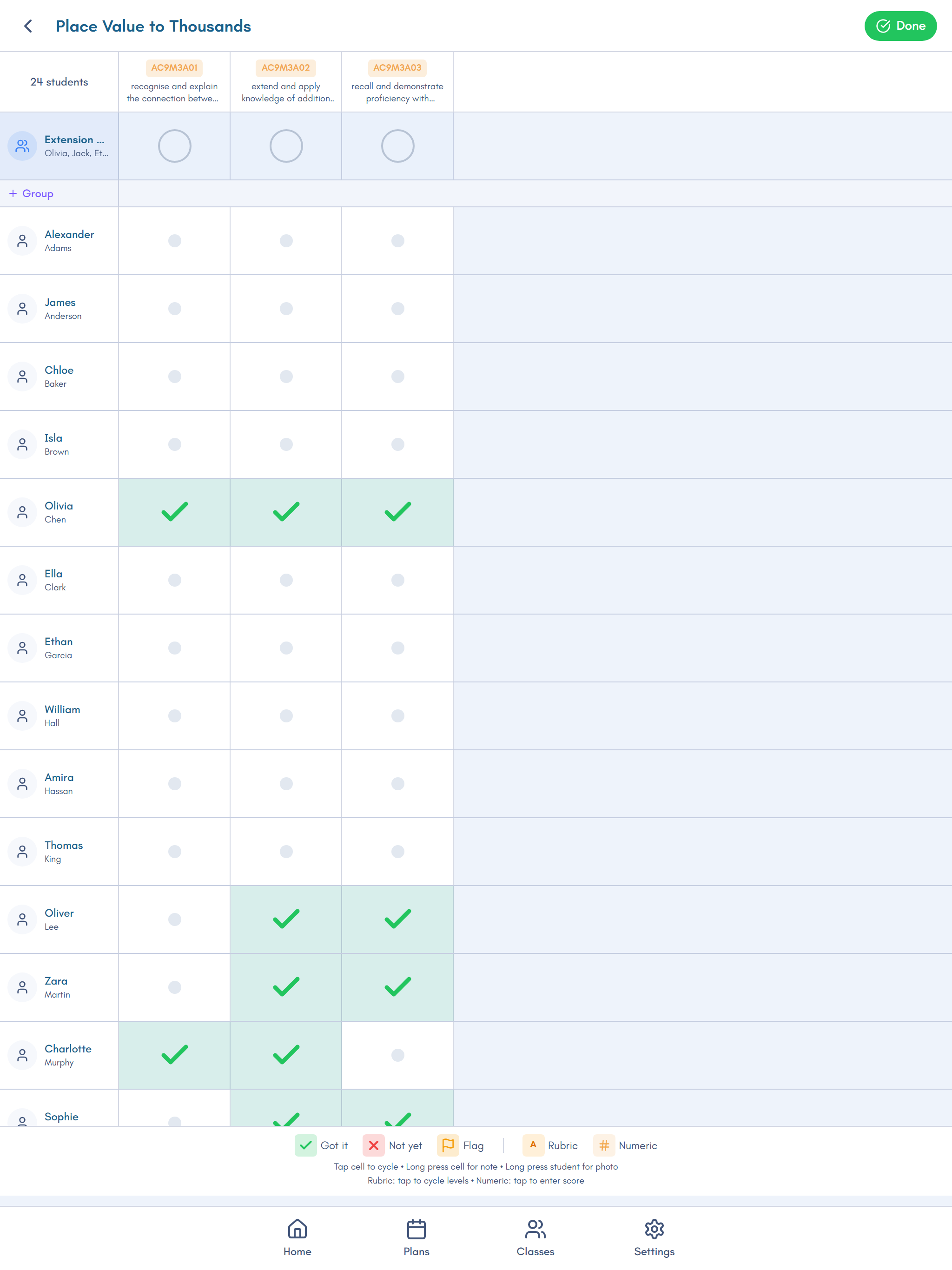
It looks a bit like the spreadsheet I always wanted, which is not a coincidence. Students down one side, skills across the top. The difference is that it's built for tapping, not typing.
While I'm circulating, I've got the marking grid open. I check in with a student, see where they're at, and tap the cell. Rubric level or a quick numeric score, done, moving on. It genuinely takes a couple of seconds, which matters, because anything slower than that and I know from experience I'll stop doing it.
The Australian Curriculum content descriptors are already loaded for every year level, so when I start a new unit I'm picking skills from a list rather than writing them from scratch. If I want to track something more specific, I add a custom skill. Attendance lives in the same app, which means it's already open at the start of the lesson anyway.
And because every tap lands in the same place, the "sit down and enter the data" step doesn't exist any more. The data entry happened during the lesson, in the moments I was already assessing.
The Part I Didn't Expect
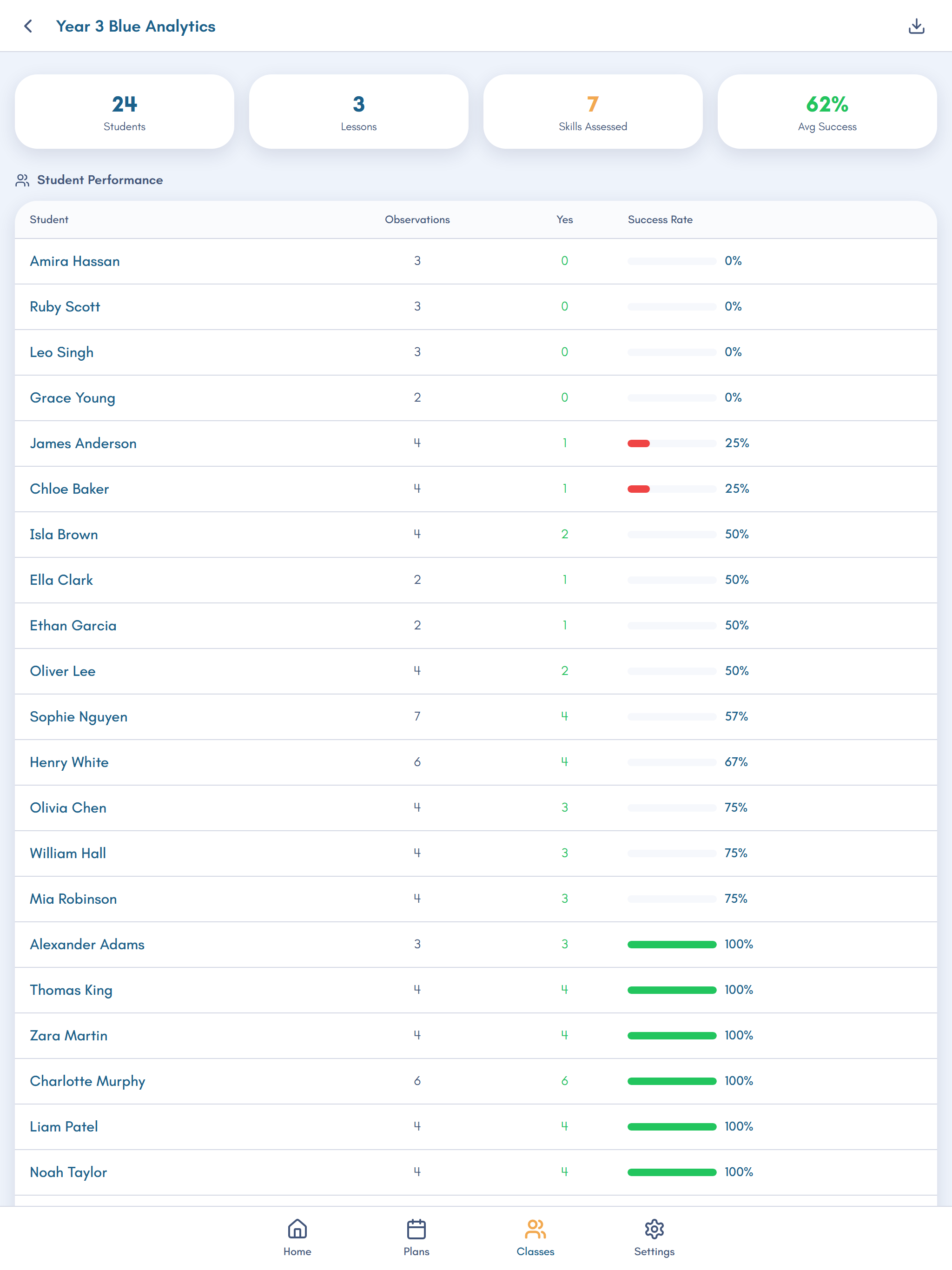
The obvious win is time. The one I didn't see coming is what consistent data actually shows you.
When I was updating a spreadsheet fortnightly from memory, the data mostly confirmed what I already believed about each student. When I started capturing observations in the moment, the data started surprising me. Quiet students who I'd mentally filed as "fine" turned out to have gaps I'd been glossing over. Skills I assumed the class had nailed showed a messier picture.
That's the point of tracking skills in the first place. Not to have a colourful grid for your own peace of mind, but to catch the things your gut gets wrong. A spreadsheet updated from memory can't do that, because it only ever contains your gut.
Reporting time is the other payoff. Instead of scrolling back through my planner trying to reconstruct a term of evidence, it's already sitting there, dated and organised by skill.
If You're Still in Spreadsheet Land
I'm obviously biased here, I built the thing. So I'll say this instead: whatever tool you use, the test that matters is whether you can record an observation in the middle of teaching without breaking stride. If you can't, the system will quietly die, the same way every one of my spreadsheets did.
If you want the longer story on why I think most assessment admin fails, I wrote about it in formative assessment without the paperwork.
Share your thoughts on this post
No comments yet. Be the first to share your thoughts!