Formative assessment is one of those things that sounds simple until you actually try to do it consistently. Check where students are at during the lesson. Adjust your teaching based on what you see. Makes total sense.
The problem is everything that comes with it: the checklists, the tracking, the admin. By the time you've set up a system to capture what you're observing, you've created more work for yourself, not less.
The Paper Checklist Trap
I've tried the paper checklist approach. Print out a class list, write the skills down the side, tick boxes as I circulate. Simple enough in theory.
In practice? The checklist gets lost in a pile. Or I forget to bring it to the floor when I'm doing guided reading. Or I fill it in but then have to transfer that data somewhere else anyway. Or I make one for a specific lesson and then never use it again because creating a new one for every focus takes too long.
Paper checklists feel organised. They look like you've got your assessment sorted. But they don't actually save time. They just move the work around.
Mini Whiteboards Are Great, But Then What?
I use mini whiteboards all the time for whole-class checks. Everyone writes, boards up, I scan the room. Instant snapshot of who's got it and who hasn't.
But here's the thing: I see the information, I respond to it in the moment, and then it's gone. I might make a mental note that a few students struggled, but I'm not recording it anywhere. By the end of the day, I've forgotten the specifics.
Whiteboards are great for in-the-moment teaching. They're not great for tracking progress over time, unless you've got a way to capture what you're seeing as you see it.
Exit Tickets Still Need Work
Exit tickets are useful. A quick question at the end of the lesson, students jot down their answer, you collect them and see where everyone's at.
But they still need creating. And organising. And reading through after the lesson. And then doing something with that information.
It's not that exit tickets are bad. It's that they're another thing to prepare, another thing to collect, another thing to process. If you're already stretched for time, they become one more task that either gets done inconsistently or adds to the pile of "I'll look at that later."
What I Actually Wanted
I wanted to capture formative assessment data while I was teaching, without creating extra work before or after the lesson.
That meant something I could use while roaming the room. Something that didn't require me to prepare custom checklists for every lesson. Something where the skills were already there, ready to check off when I observed them.
That's what I built with CheckTally.
How CheckTally Works
CheckTally has a complete bank of content descriptors and elaborations for every year level from the Australian Curriculum. They're all there, ready to use as assessment criteria. You can use them as-is, or link them to custom skills if you've got specific things you're tracking.
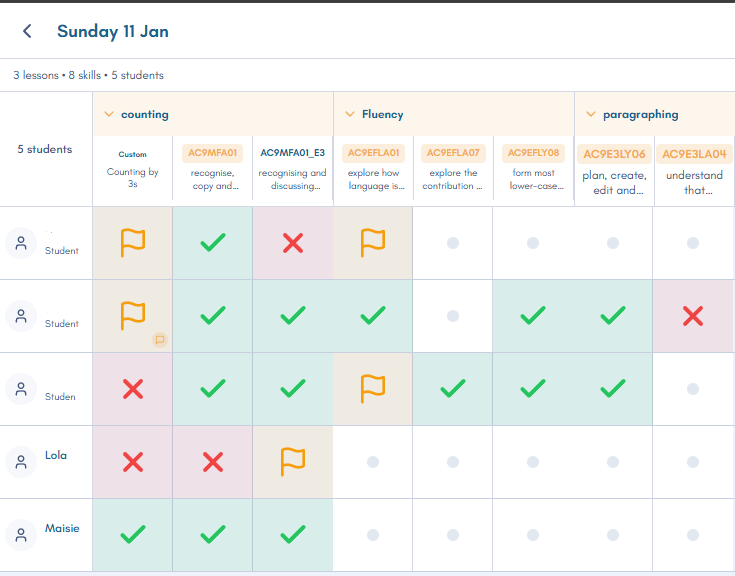
I use it primarily on my iPad. While I'm circulating during a lesson (checking work, asking questions, observing students), I can tap to record what I see. Student demonstrated that skill? Check. Student needs more support? Note it. It takes seconds, and the data's captured right there.
No printing checklists beforehand. No transferring paper notes to a spreadsheet afterwards. No forgetting what I observed by the time I get back to my desk.
Capturing What You Already See
Here's the thing about formative assessment: teachers are already doing it constantly. Every time you glance at a student's work, ask a question, or notice someone's struggling, that's formative assessment. You're gathering information and adjusting.
The problem is that most of that information stays in your head, gets used in the moment, and then disappears. You're assessing all the time, but you're not capturing it.
CheckTally doesn't change how I teach. It just lets me record what I'm already observing without breaking my flow. I'm still roaming, still checking in with students, still adjusting my teaching. I'm just tapping a screen as I go instead of relying on memory.
Why Tracking Matters
When you actually capture formative assessment consistently, patterns emerge. You start to see which skills are solid across the class and which need revisiting. You notice students who are quietly struggling with something you assumed was fine. You've got data to inform your planning instead of just a vague sense of how things went.
And when it comes to reporting time, you're not scrambling to remember what students can do. You've already got it recorded.
Where It's At
CheckTally is part of my launch alongside SpellTally and TebTally Pro. The content descriptor bank is built for the Australian Curriculum, so it's most useful for Australian teachers, but you can create custom skills for anything you're tracking.
If formative assessment has felt like one more thing to add to your workload, it might be worth a look. The goal isn't to do more assessment. It's to capture what you're already doing without the paperwork.
I wrote about a similar problem with behaviour logging in why nobody logs behaviour. Turns out the same design principles apply.
Share your thoughts on this post
No comments yet. Be the first to share your thoughts!