I've always believed in testing spelling properly. Not just handing out a list on Monday and hoping kids memorise it by Friday, but actually checking what's going on, where they're making mistakes, what patterns they're missing, whether they're actually learning or just cramming and forgetting.
The problem is that doing it properly takes forever.
One-on-One Testing Sounds Great Until You Try It
In an ideal world, I'd sit with each student individually, read their words aloud, watch them write, and see exactly where things go wrong. Is it a vowel sound issue? Are they guessing at suffixes? Do they actually understand the word or just know the letters?
That kind of insight is genuinely useful. But it also means I need 25 separate testing sessions while the rest of the class does... what, exactly?
Independent activities. Which sounds fine until you realise that's 20+ minutes of literacy time where I'm not actually teaching anyone. I'm stuck at a desk with a clipboard while the rest of the class rotates through busy work. That's less time for explicit instruction, guided feedback, writing practice, all the things that actually move kids forward.
So you make a trade-off. You get better data on spelling, but you lose instructional time to get it. Some weeks that feels worth it. Most weeks it doesn't.
Partner Testing Loses the Point
The obvious workaround is partner testing. Pair kids up, have them test each other, collect the papers. Done in ten minutes, everyone's involved, no independent activity circus required.
But here's what you lose: everything that made individual testing worthwhile in the first place.
When a student tests their partner, they're not noticing that Sarah always mixes up "ei" and "ie." They're not catching that Tom rushes through and doesn't check his work. They're definitely not picking up on the kid who's looking to copy off any words they can find on the walls.
You get a score at the end. But the score doesn't tell you much. You don't see the thinking, the hesitation, the patterns. You just see 7/10 and move on.
The Paper Problem
Let's say you push through and do proper testing anyway. Now you've got a stack of spelling tests to mark. Not hard, just tedious. And once you've marked them, then what?

If you're doing it right, you're recording scores somewhere. A spreadsheet, a markbook, your school's LMS. More time. More clicking. More admin that eats into your afternoon.
And the papers themselves? Filing them feels pointless, but throwing them out feels wasteful. So they end up in a tray somewhere, slowly forming a geological record of the term that you'll definitely sort through later. (You won't.)
I've lost count of how many hours I've spent on the loop of: print lists, run test, collect papers, mark papers, enter data, file or bin papers, repeat. None of that is teaching. It's just... maintenance.
Creating Lists Is Its Own Time Sink
Before any of that even happens, you need to build the list. If you're differentiating, that might mean multiple lists for different groups. Each word needs a definition if you're testing understanding. You probably want a sentence for context.
So now you're spending your Sunday afternoon typing up "necessary: required or essential; I packed the necessary supplies for the camping trip" twenty times over for three different groups.
It's not difficult work. It's just slow. And it adds up, week after week, until spelling test prep becomes this low-grade dread hanging over your weekend.
What I Actually Wanted
I wanted something that let me set a list once, tailored to each student if needed and then just... let it run. Students could practise during the week and complete the test when I was ready, without me reading words aloud thirty times or losing half my literacy block.
I wanted the data captured automatically. No marking, no spreadsheet entry, just results I could actually look at and learn from.
I wanted to know if a student was tabbing out to Google or pasting answers in.
And I really, really didn't want to write another definition and example sentence ever again.
So I Built It
That's why I made SpellTally. I've been testing it with my class for a term now, and it's solved almost everything I was frustrated about.
I set up each student's list once a week, customised to their level and the rest is automatic. They log in, practise throughout the week, and complete the test when I schedule it. The app generates definitions and sentences, so I'm not spending my time typing them out. I get alerts if someone tabs out or tries to paste, so I know when to have a quiet conversation about academic honesty.
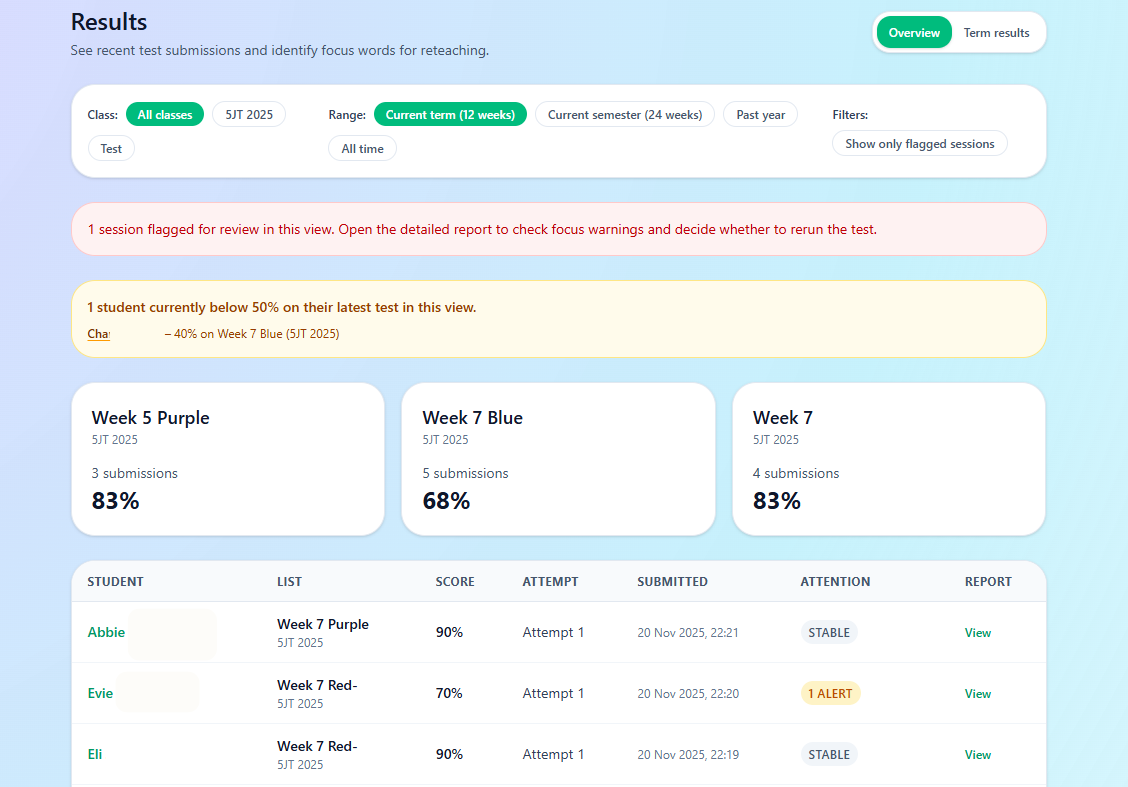
Most importantly, I've got my literacy time back. No more one-on-one testing marathons. No more stacks of paper to mark and file. The data's just there, tracked over time, showing me who's growing and who needs more support.
I've genuinely noticed improvement in my class's spelling this term. Whether that's the app or just having a more consistent system, I'm not sure. Probably both. Either way, I'm not going back to the old way.
If spelling tests have been feeling like a time sink for you too, SpellTally might help. I'm opening it up for other teachers to try in late January, I'll share more details here when it's ready.
If you're looking for ways to make spelling practice more engaging in the meantime, I wrote about 5 spelling activities I actually use in my classroom.
Share your thoughts on this post
No comments yet. Be the first to share your thoughts!