I'm not going to pretend I invented any of these. Most came from programs, PD sessions, or YouTube rabbit holes during planning time. But these are the ones that stuck, the activities I keep coming back to because they actually work and my students genuinely engage with them.
1. The Spelling Game
I found this one on YouTube a while back and it's become a class favourite. The basic format is simple, but I usually put my own twist on it to keep engagement high, adding team competitions, changing up the elimination rules, or letting students take turns being the "caller."
It's one of those activities that feels like a game first and spelling practice second, which is exactly why it works. I don't use it every week, but when I pull it out, the kids are immediately into it.
2. SoundWaves Warm-Up Games
The SoundWaves program has a bunch of warm-up games built in, but there are three I keep coming back to: Grapheme Relay, Spelling Bingo, and Spelling Noughts and Crosses.
Grapheme Relay is great for getting kids moving and thinking quickly. Spelling Bingo works well when I need something a bit calmer but still engaging. And Noughts and Crosses adds just enough competition to keep everyone focused without things getting too chaotic.
There are other warm-ups in the program, but these three hit the sweet spot for my class, quick to set up, easy to explain, and genuinely fun.
3. Segmenting Practice
This one's a phonics staple and honestly nothing revolutionary, but it's effective. I have students segment their weekly spelling words as part of their regular practice, breaking words into individual phonemes and graphemes to really understand how they're built.
What I've added is "challenge segments" where I throw in trickier words and students can earn class points for getting them right. It adds a bit of stakes without being high pressure, and it keeps the stronger spellers engaged while we work through the basics together.
Segmenting is one of those activities that looks simple but does a lot of heavy lifting. When students can pull a word apart sound by sound, they're not just memorising, they're actually understanding how spelling works.
4. Mini Whiteboards
I know, not exactly groundbreaking. But mini whiteboards are genuinely one of the most useful tools I have for whole-class explicit instruction.
Everyone writes, everyone holds up their board, and I can see instantly who's got it and who's struggling. No waiting for hands to go up, no relying on the same three confident kids to answer. It's immediate feedback for me and low-stakes practice for them.
I use them for all sorts of things, but for spelling they're perfect. I say a word, they write it, board up, and we discuss. Quick corrections, no rubbing out in books, no one feels singled out. It's simple, but it works.
5. SpellTally Practice Activities
This one's mine, so I'm biased, but I built it because I wanted exactly this.
The student side of SpellTally includes practice activities like segmenting exercises that help students learn their words through daily practice before they take their test. It's not just "look at the list and memorise." They're actively working with the words, hearing them, breaking them down, and building familiarity before test day.
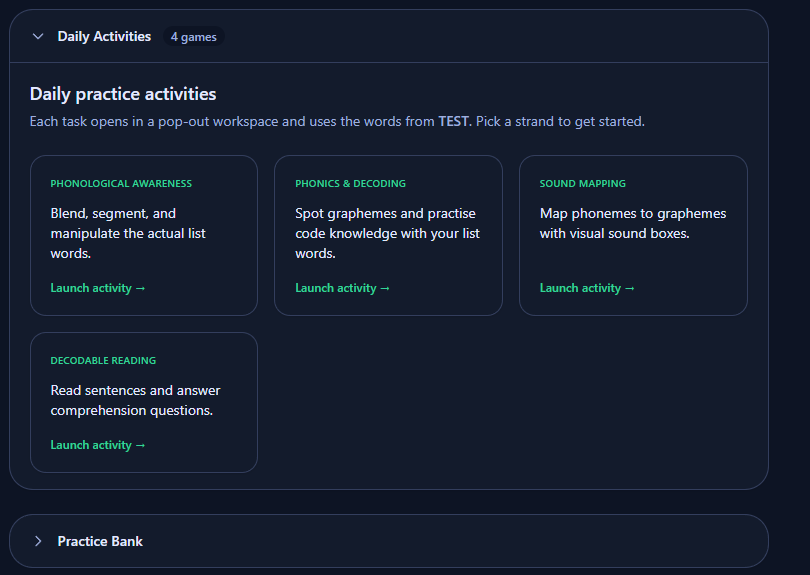
I wanted something my students could do independently that wasn't just busywork, something that actually reinforced how words are constructed. And I wanted it to feed into the test itself, so practice and assessment were connected rather than separate activities.
It's been working well with my class since last year. Students are coming to their spelling tests having already engaged with the words multiple times, which means fewer surprises and better results.
What Works for Your Class?
These five aren't the only spelling activities out there, not even close. But they're the ones I reach for regularly because they fit how I teach and how my students learn.
The common thread? They're all active. Students aren't just staring at a list hoping the words sink in. They're playing, competing, writing, segmenting, practising. That's what actually builds spelling skills.
If you've got activities that work for you, I'd love to hear about them. And if you're curious about SpellTally, I wrote about the problem with traditional spelling tests and why I built it.
Share your thoughts on this post
No comments yet. Be the first to share your thoughts!